
Did you know a single penguin colony can become bigger than the population of some small cities? These creatures are more than just cute in their tuxedos. They’ve perfectly adapted to survive on land and in icy waters. Penguins are known for their “tuxedo” plumage. They’ve become experts of the sea and land, forming “waddles” and “rafts”.
Every dive and march across the ice tells a story of penguin behavior. They use camouflage and social dynamics for survival. As you learn about penguins, you’ll see why they’re fascinating. Their survival is tied to their unique behaviors.
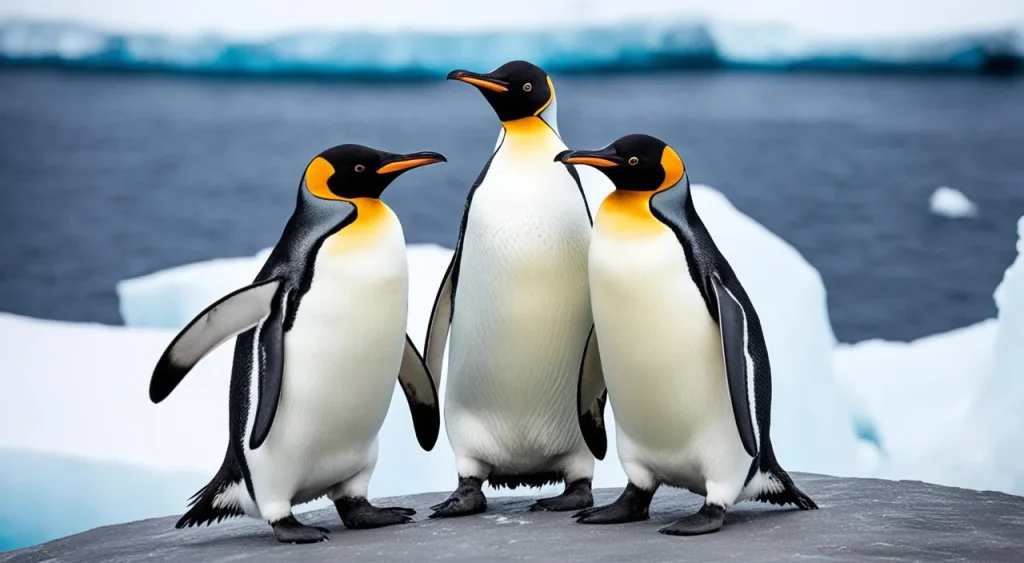
Table of Contents
Key Takeaways
- Witness the remarkable “waddle” and “raft,” social formations characteristic of penguin colonies that aid in protection and hunting.
- Learn about the counter-shading camouflage of penguins, a unique behavior that offers them stealth from predators.
- Discover the intricacies of penguin behavior such as their strategic huddling for survival in extreme cold climates.
- Understand the role of their distinctive black and white “tuxedo” in their survival strategies.
- Explore the fascinating adaptability of penguins to both land and sea environments, a factor crucial to their resilience.
The Unique Social Dynamics and Camouflage of Penguins
Penguins have fascinating strategies for living in icy places. Their social life and how they act on land and water help them survive. Learning about these behaviors shows how strong and adaptable these birds are.
The Significance of Waddles and Rafts in Penguin Communities
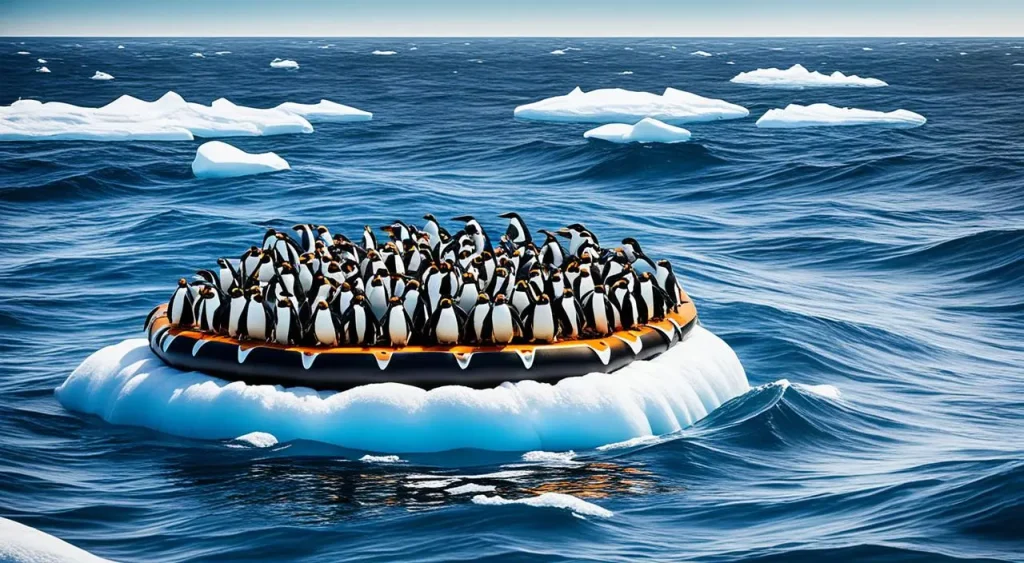
In their natural settings, penguin colonies show amazing group behaviors. They move in large groups called penguin waddles on land. This helps them deal with predators. In cold waters, they form groups called penguin rafts. This keeps them warm and helps them move together.
Understanding the ‘Tuxedo’ Look: Countershading Camouflage
Penguins’ black and white feathers aren’t just for looks. They are crucial for penguin camouflage. This trick helps them hide from enemies in the water. The color contrast helps them blend in, whether it’s against the dark ocean floor or the bright surface.
Why Penguins Huddle: Survival in the Extreme Cold
The penguin huddles are very touching. Penguins get very close to keep warm in the freezing weather. They protect their weak ones this way. These huddles show how well penguins understand to stay warm together in cold places.
| Behavior | Function | Benefit |
|---|---|---|
| Penguin Waddle | Land travel and predator avoidance | Safety in numbers |
| Penguin Raft | Swimming and thermal regulation | Reduced heat loss, collective navigation |
| Countershading Camouflage | Stealth in ocean waters | Protection from predators |
| Penguin Huddles | Thermal regulation in cold climates | Survival during extreme cold |
Adaptations and Habitats: How Penguins Are Built for the Sea
Imagine swimming penguins gliding through the water smoothly. This scene shows the impressive result of penguin adaptations developed over millions of years. These birds have solid bones, unlike other birds that can fly. Their bones are not hollow but heavy. This makes it easy for penguins to dive deep and move around underwater. It turns the sea into a place where they can thrive.
Penguins have another amazing trait: their waterproofing ability. They have a special gland that produces oil. Penguins use their beaks to spread this oil over their feathers. This keeps their feathers in top shape and helps them stay warm. It is especially important when they swim long distances in the ocean to find food.
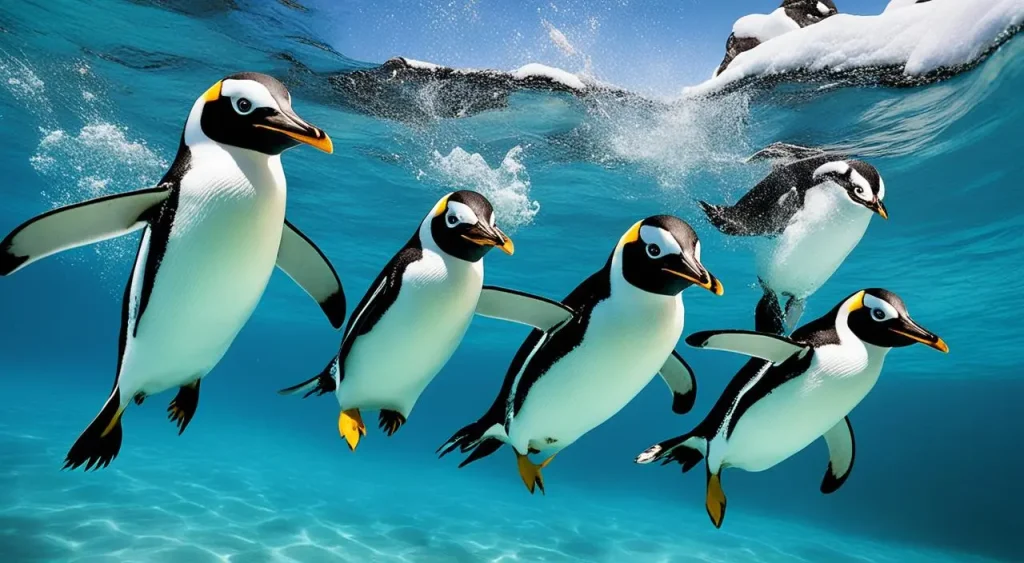
Different penguin species live in a wide range of penguin habitats. They thrive everywhere from the icy lands of Antarctica to the warmer shores of New Zealand and South Africa. Penguins can live in many places where other birds cannot. This is because they can adapt well to various environments. Their special skills help them face different weather conditions.
Getting to know how penguins adapt and where they live shows us how amazing they are. Even though they might look strange on land, their bodies are perfect for life in water. This tells us a lot about their evolution. It shows how penguin types differ from one place to another. And it reveals how closely their lives are tied to their surroundings.
Penguin Relationships and Breeding Rituals
Exploring the world of penguin relationships, their unique breeding rituals captivate us. These flightless birds showcase complex and heartwarming behaviors in their icy habitats.
Romancing with Pebbles: The Role of Gifting in Courtship
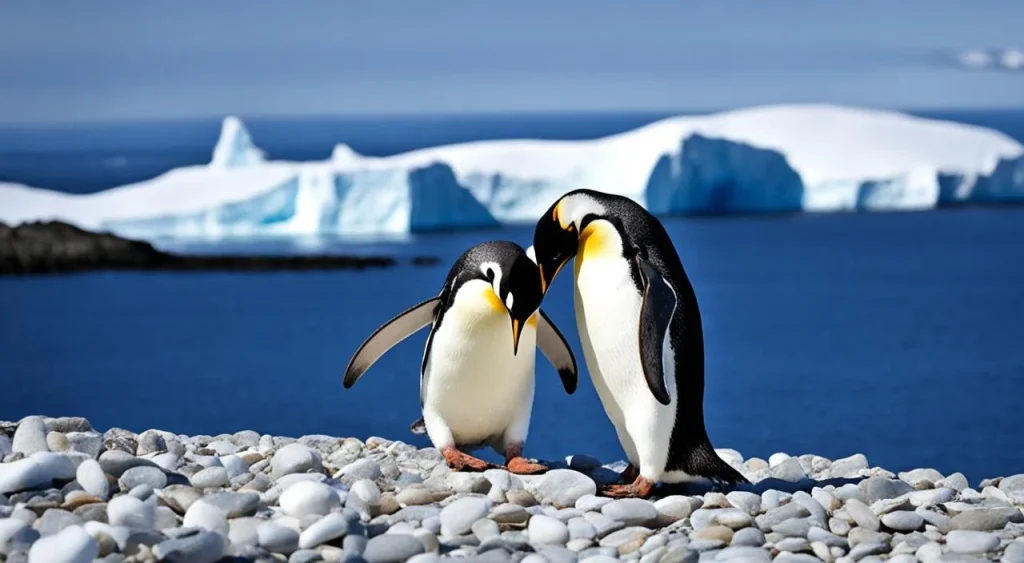
Pebble gifting is key in penguin courtship. Not just ordinary rocks, these pebbles symbolize interest and commitment. Male penguins carefully choose pebbles for their mates. This gesture is the start of their nest and signifies the beginning of a potential lifelong connection.
Enduring Partnerships: Monogamy and Co-Parenting in Penguin Species
Some penguins form lifelong pairs, like Magellanic and Gentoo species. These monogamous penguins are known for their strong bonds. They share the duties of egg incubation and raising their young equally. This teamwork in parenting shows their advanced social structure.
| Species | Pebble Gifting | Monogamy | Co-Parenting Role |
|---|---|---|---|
| Magellanic Penguins | Yes | Lifelong | Equal sharing |
| Gentoo Penguins | Yes | Lifelong | Equal sharing |
| Other Penguin Species | Varies | Varies | Varies; some species may have less involvement from male |
Understanding penguin relationships can deepen our insight into these birds. Watching them court, breed, and parent shows us a bit of ourselves. Their nurturing ways are a fascinating part of their nature and resemble human caring behaviors.
Conclusion
As you’ve explored the realm of these fascinating seabirds, you’ll see why penguins in the wild are so special. Yet, we must worry about their future. The impact of climate change effects is changing their icy homes dramatically. We must see penguin conservation as an urgent call to protect them. These incredible creatures, expert swimmers with their flippers, are vital to our natural world.
The tale of endangered penguins highlights a bigger environmental crisis. Almost half of the penguin species are nearing endangerment. This fact urges us to address climate change, overfishing, and habitat loss. We can’t just acknowledge their situation; we must act and support efforts to save them.
Discovering various penguin species, from the majestic Emperor to the lively Little Penguin, makes us appreciate their role more. Their future and ours are linked. By caring for their habitats, we commit to a future where nature thrives. Let’s work together to protect our planet’s incredible diversity for all coming years.
FAQ
What unique behaviors are characteristic of penguins?
Penguins are known for socializing in large groups. They form tight huddles for warmth. They also engage in complex courtship rituals, like giving pebble gifts.
Their swimming is very efficient. They have a distinctive “waddle” on land. These are key behaviors of these birds.
Can you explain the social dynamics within penguin colonies?
Penguin colonies, called waddles or rookeries, show complex social interactions. They live, breed, and hunt together. This helps them protect against predators and survive cold climates.
The way these colonies work shows how they cooperate in offense and defense.
How does countershading camouflage benefit penguins?
Countershading camouflage helps penguins stay hidden in the ocean. Their dark backs blend in with the ocean depth from above. From below, their white bellies match the bright surface light, making them hard to see by predators.
Why do penguins form huddles, especially in cold environments?
Penguins huddle to keep warm in cold places, like Antarctica. This tactic helps them fight off the cold. In these huddles, penguins take turns being on the outside, sharing the warmth equally.
What adaptations help penguins thrive in aquatic environments?
Penguins are well adapted for water. They have solid bones for better diving. A layer of blubber keeps them warm.
They have flippers for swimming and a special gland for waterproofing feathers. These features make them great swimmers.
How do penguin breeding rituals and relationships look like?
Penguin breeding rituals involve giving pebbles as gifts. These pebbles are also used to build nests. Gentoo penguins, for instance, are monogamous and share parenting duties.
Such rituals and relationships highlight strong bonds between penguin pairs.
Are penguins endangered, and what threats do they face?
Many penguin species are at risk. Climate change affects their food and homes. Overfishing reduces their food.
Human activities also destroy their habitats. These are big challenges for penguins.
What can be done to aid in penguin conservation?
Helping penguins involves protecting their habitats and setting up marine reserves. Reducing carbon emissions is also vital.
Further research and raising awareness are crucial too. This way, everyone can understand and help penguins better.
Source Links
- https://www.cabq.gov/artsculture/biopark/news/10-cool-facts-about-penguins
- https://www.audubon.org/news/10-fun-facts-about-penguins
- https://www.visitsealife.com/sydney/information/news/5-fun-facts-about-penguins/
You may also like:
- “Hours of Fun and Learning”: Why the Book The Fascinating Animal Book for Kids: 500 Wild Facts! is a Hit
- Raccoon Facts: Nature’s Mischievous Bandit
- Discover Fascinating Penguin Facts & Behavior
- “They’re Disappearing!” The Animals We May Lose Before Your Pet Gets Old [animals going extinct]
- 7 Reasons Your Saint Bernard is Drooling Excessively (and What to Do)